
Product Description
C/SiC Carbon-Ceramic Composite Materials
Key Features & Advantages
- Thermal Stability: Interface design (e.g., alternating PyC/SiC layers) and matrix modification help reduce thermal expansion and suppress microcracks, ensuring dimensional stability at high temperatures.
- Oxidation Resistance: Ceramic coatings such as SiC and HfC effectively block oxygen diffusion, providing oxidation protection even above 2200°C.
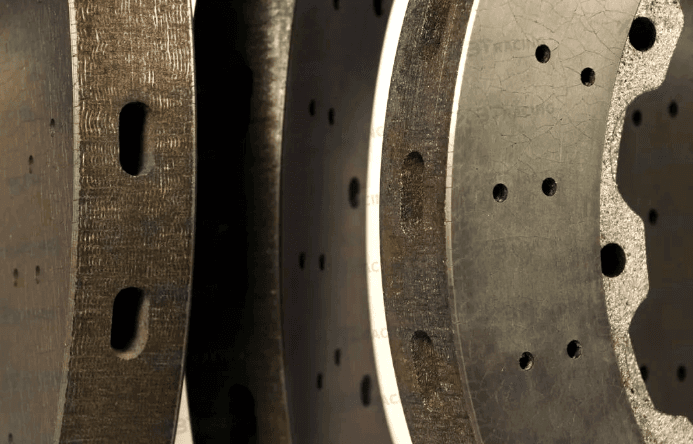
- Friction Performance: Stable friction coefficient and low wear rate at temperatures over 1000°C, ideal for braking systems under extreme conditions.
Manufacturing Technology
- Preform Construction: Conventional: Needle-punched or stitched fiber preforms form porous C/C bodies via CVI, followed by SiC matrix introduction through RMI.
- Additive Manufacturing: Uses laser sintering or digital light processing to create short-fiber reinforced preforms, simplifying complex shapes and reducing costs.
- Densification Methods: CVD (Chemical Vapor Deposition): Deposits PyC interface and SiC matrix for stronger bonding.
- PIP (Precursor Infiltration & Pyrolysis): Repeated impregnation and pyrolysis with SiC precursor reduces porosity.
- RMI (Reactive Melt Infiltration): Molten silicon reacts with carbon to rapidly form a dense SiC matrix.
Applications
- Aerospace: Thermal protection systems (e.g., nose cones, panels) and brake components; used in Porsche brake discs and heavy-duty truck pads.
- Rail Transit: Maglev train skids and high-speed train brake pads; replaces metal to reduce weight and improve durability.
- Defense & Military: Ultra-high-temperature oxidation-resistant parts for hypersonic vehicles; long-term protection above 2200°C with HfC/ZrB₂ coatings.
Product Details
- Product
- Thermal-Resistant C/SiC -2
- Category
- C/SiC Composites
Interested in Thermal-Resistant C/SiC -2?
Contact us to discuss specifications, pricing, and custom formulation options.
Request a Quote